
Bairros do Rio
Living in central Rio de Janeiro: what to consider
Transport, shops, the rhythm of the area and the kinds of building: what weighs on daily life for those living in the city centre.
Reforma e acabamento
Common in older buildings in Rio, herringbone parquet can be recovered. See how to identify its condition and what to do day to day.
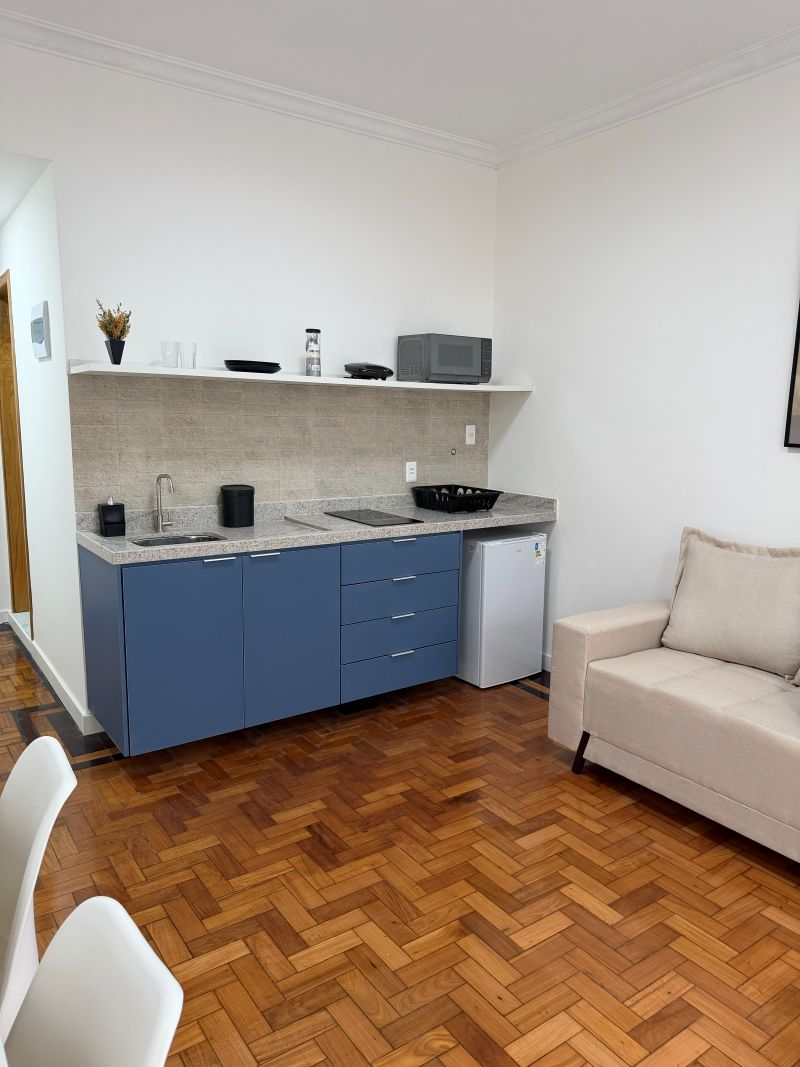
If you have ever visited older apartments in central Rio or in Botafogo, you have probably walked on herringbone parquet. It is one of the finishes that most defines buildings put up in the first half of the twentieth century, and it is coming back strongly in renovations that prefer to preserve rather than replace.
Parquet is a wooden floor made of small, solid pieces, glued or nailed onto a subfloor. Unlike a plank floor, where the boards are long and aligned, parquet is laid with short pieces.
In the herringbone pattern, each piece is set at an angle to the previous one, forming a "V" that runs diagonally across the room. The result is a floor with visual movement, which changes as the light falls on it.
It is a solid wood floor. That means it can be sanded and given a new coat of varnish several times over its life. That is the main reason it is worth assessing recovery before thinking about replacing it.
It was a common finish in residential and commercial construction of the period, because of the combination of durability, cost and the availability of timber. Many buildings in the centre and in older neighbourhoods were handed over with this floor.
Over the decades, part of that stock was covered with other materials: carpet, vinyl, porcelain tile. In many cases the parquet is still underneath, preserved.
Not every parquet floor can be recovered, but most can. The assessment is simple and needs no tools:
In general, a floor with a few loose pieces, no damp and no woodworm is sorted with sanding and a new top coat.
Solid wood asks for little, but it asks consistently.
From a practical point of view, preserving usually makes sense when the floor is structurally sound. The cost of recovery tends to be lower than replacing it with another material, and the result is a solid wood floor, which does not exist at the same price in laminate options.
There is also a market reason: in older buildings, herringbone parquet is a differentiator. People looking for that kind of property are often looking for exactly that.
Replacing starts to make sense when there is structural damage, recurring damp with no solution, or advanced woodworm.
Some units that have been through Portalis's renovation kept the herringbone parquet and received a new finish. The result can be seen in the photographs:
If you want to know what was preserved in a specific unit, talk to the team. Because we follow the work, we can answer what was kept and what was replaced.
Bairros do Rio
Transport, shops, the rhythm of the area and the kinds of building: what weighs on daily life for those living in the city centre.
Compra e decisão
A renovation done is not the same as a renovation done well. A guide to what to look at in services, finishes and paperwork befor…